My Twenty Dollar Bet on Spencer Pratt
I made another small prediction-market bet.
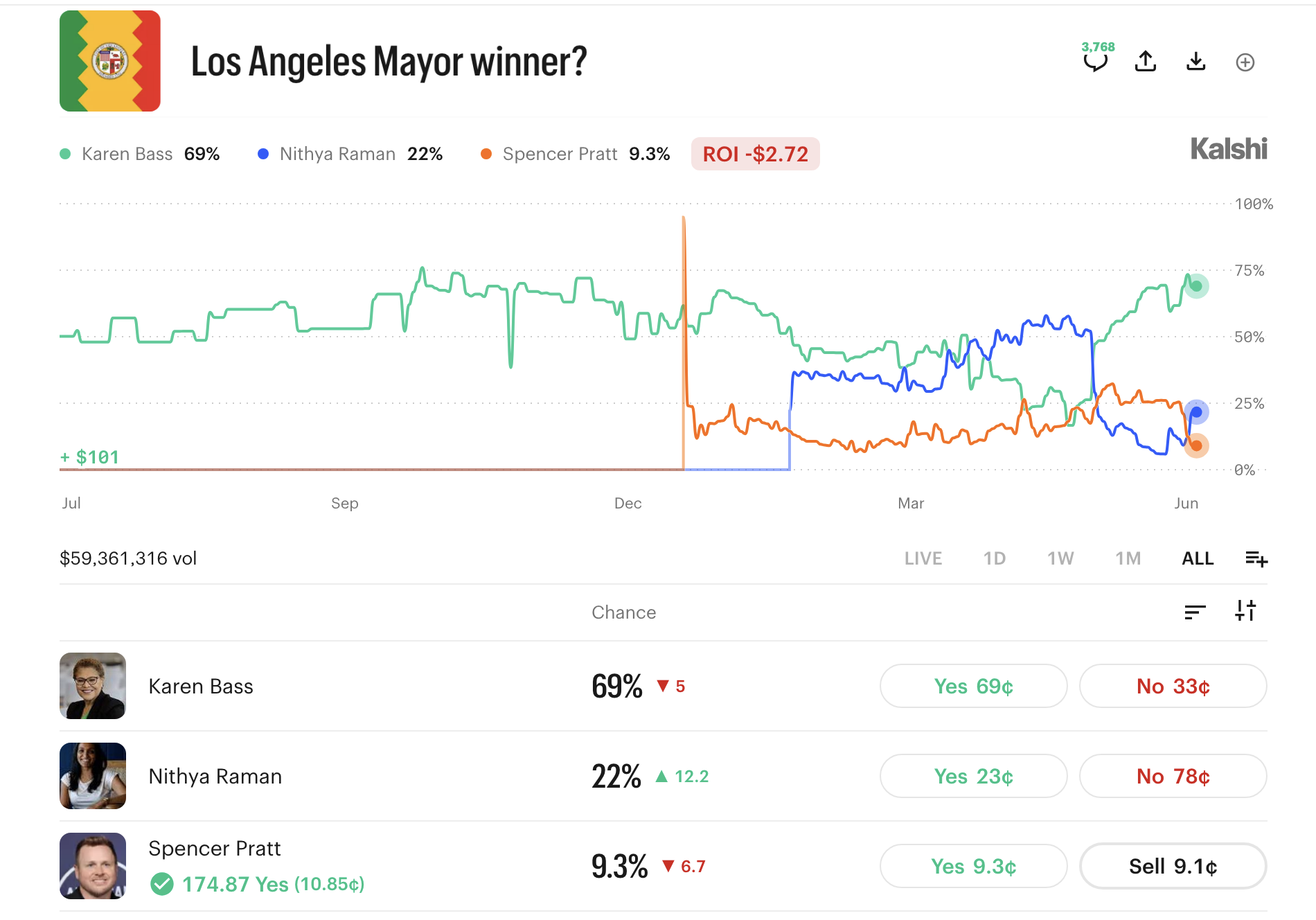
I bought Spencer Pratt to win the Los Angeles mayoral election.
As I write on June 4, Kalshi has Karen Bass favored. Bass has already advanced to the November runoff. Pratt, meanwhile, is competing with Nithya Raman for the second spot as ballots continue to be counted.
There are good reasons to bet against Pratt.
Los Angeles is a deeply Democratic city. Bass is the incumbent. She has institutional support, including organized labor and major Democratic figures. In a runoff, many Democratic and progressive voters who were dissatisfied with Bass in the first round may still come home to her if the alternative is a Republican celebrity outsider.
There is also Nithya Raman.
Bass is the incumbent Democrat running on continuity and governing experience, though she has been weakened by frustration over homelessness, public safety, housing, and the city’s response to the fires. Raman is the progressive alternative, the candidate for voters who think Los Angeles needs a different kind of Democratic governance. Pratt is the outsider candidate, drawing on frustration with the political class, anger over disorder and fire response, and his own ability to command attention.
As of this writing, Pratt may not even make the runoff. That is the first uncertainty. California counts slowly, and late ballots can change the shape of a race. If Raman overtakes him, the Pratt bet dies before the general election even begins.
So why buy Pratt?
Because unlikely is not the same thing as overpriced.
With Pratt receiving just under thirty percent of the vote in the count so far, he may have a higher chance than the market initially seemed to imply.
The uncertainty cuts both ways. Late ballots may help Raman. They may reinforce Bass’s strength. They may reveal that Pratt’s support was overrepresented in the earlier count. But the early vote totals also matter. A candidate who was easy to dismiss as a novelty is now competing for a runoff spot in the second-largest city in the United States.
A reality-TV star running for mayor of Los Angeles should be easy to dismiss. But Spencer Pratt is reminding us not to let one chapter define a person. He has been a reality-TV star and crystal entrepreneur. He is also a husband, a father, a USC political science graduate, and a man whose house burned in the Los Angeles fires. He owns his past, all parts of it. He even joked on Joe Rogan that the crystals he sold for a living after reality TV had no magical powers and did not protect his house from the fire.
That kind of self-awareness matters politically. It makes him feel authentic. And it is through that authenticity that Pratt connects with people who feel that life in Los Angeles used to be better. He is not afraid to say that something has been lost: that the city used to feel more livable, that public disorder is not compassion, and that residents are allowed to want safety, beauty, normalcy, and competence. He can talk about compassion for people suffering from addiction and mental illness while also saying that cities cannot tolerate violence, open-air disorder, or cruelty, including animal abuse. He can say that people need help and that residents need order.
Then there is his use of technology.
A candidate like Pratt can make each dollar go further because he is comfortable with the media environment as it actually exists. Short clips. Podcasts. YouTube. Memes. Supporter-made videos. Direct communication. Citizen reporting. Viral moments. Long-form conversations. The kind of media that legacy campaigns still sometimes treat as unserious, even when it is where voters are actually spending their time.
Many people want to compare Pratt to Trump. With Trump’s current ratings low, that comparison is usually not meant as a compliment. But there is one way in which the comparison matters.
Trump’s 2024 media strategy showed that long-form podcasts, direct messaging, platform-native clips, friendly-but-unscripted interviews, and influencer ecosystems can matter. Joe Rogan’s interview probably did not make Trump president by itself. But it helped reveal something important about the new media environment: long-form interviews can let unconventional candidates convert skepticism into connection.
That may be especially important for a candidate like Spencer Pratt. A thirty-second attack ad can reduce him to reality-TV villain. A two-hour conversation gives him time to appear as more complex. On Rogan, he comes across as a family man: funny, informed, human, imperfect, passionate, and maybe wounded. We get to experience him at a much closer distance than the other, more produced candidates.
In this small bet, what I am really betting on is authenticity.
The question is whether Bass will adapt to that environment more successfully than Kamala Harris did in 2024. Harris considered going on Rogan but did not ultimately appear. Trump did. That contrast became part of the story of the campaign.
If Pratt advances, will Bass meet voters in the same media spaces where he is already comfortable?
Disclosure:I placed a small personal prediction-market position on Spencer Pratt winning the 2026 Los Angeles mayoral election. This essay is not investment advice. It is a reflection on prediction markets, political judgment, and the strange ways public credibility can be rebuilt.