Political Economist at Play: My First Prediction-Market Bets
I finally opened a prediction-market account.
I have understood the basic logic of prediction markets from graduate school discussions and readings, from Robin Hanson’s work on idea futures, and from a student research project I supervised a couple of years ago. But until now, I had never actually used one myself.
So I decided the practical lesson was worth about $75.
Opening the account was easy. Adding funds was easy. The whole thing took less than five minutes. Suddenly I was inside Kalshi’s strange and fascinating world: politics, weather, technology, science, and institutional uncertainty, all presented as priced claims about the future.
Kalshi even has a market asking whether the U.S. will confirm that aliens exist. When I looked, the market gave a 17 percent chance before 2027, 29 percent before 2028, and 34 percent before January 20, 2029, with more than $20 million in volume.
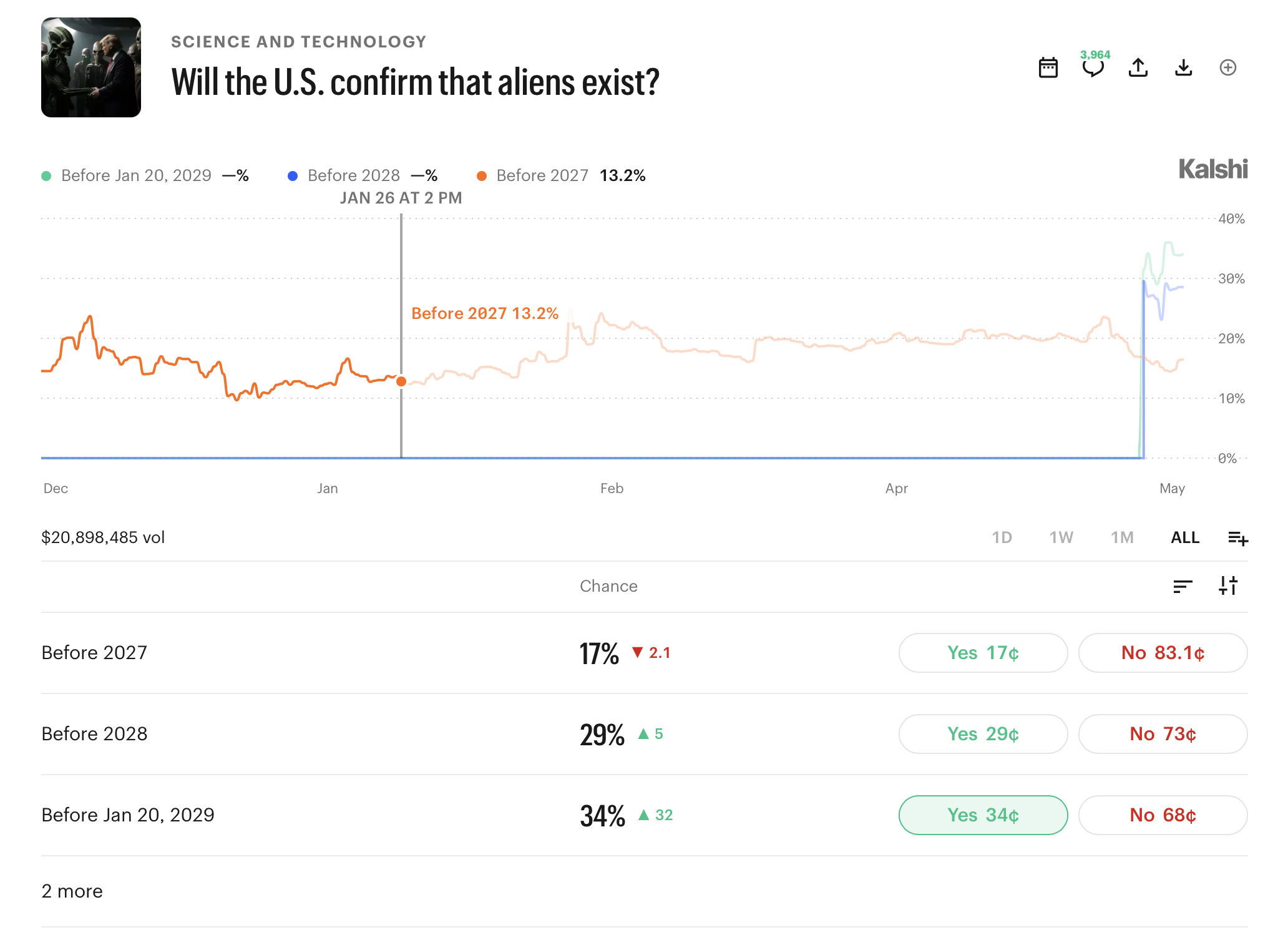
Prediction markets quickly move beyond elections. Kalshi also prices questions about science, technology, weather, and even whether the U.S. will confirm that aliens exist.
I said goodbye to the money, decided not to hedge, and bought three small positions where my intuition told me the market might be wrong.
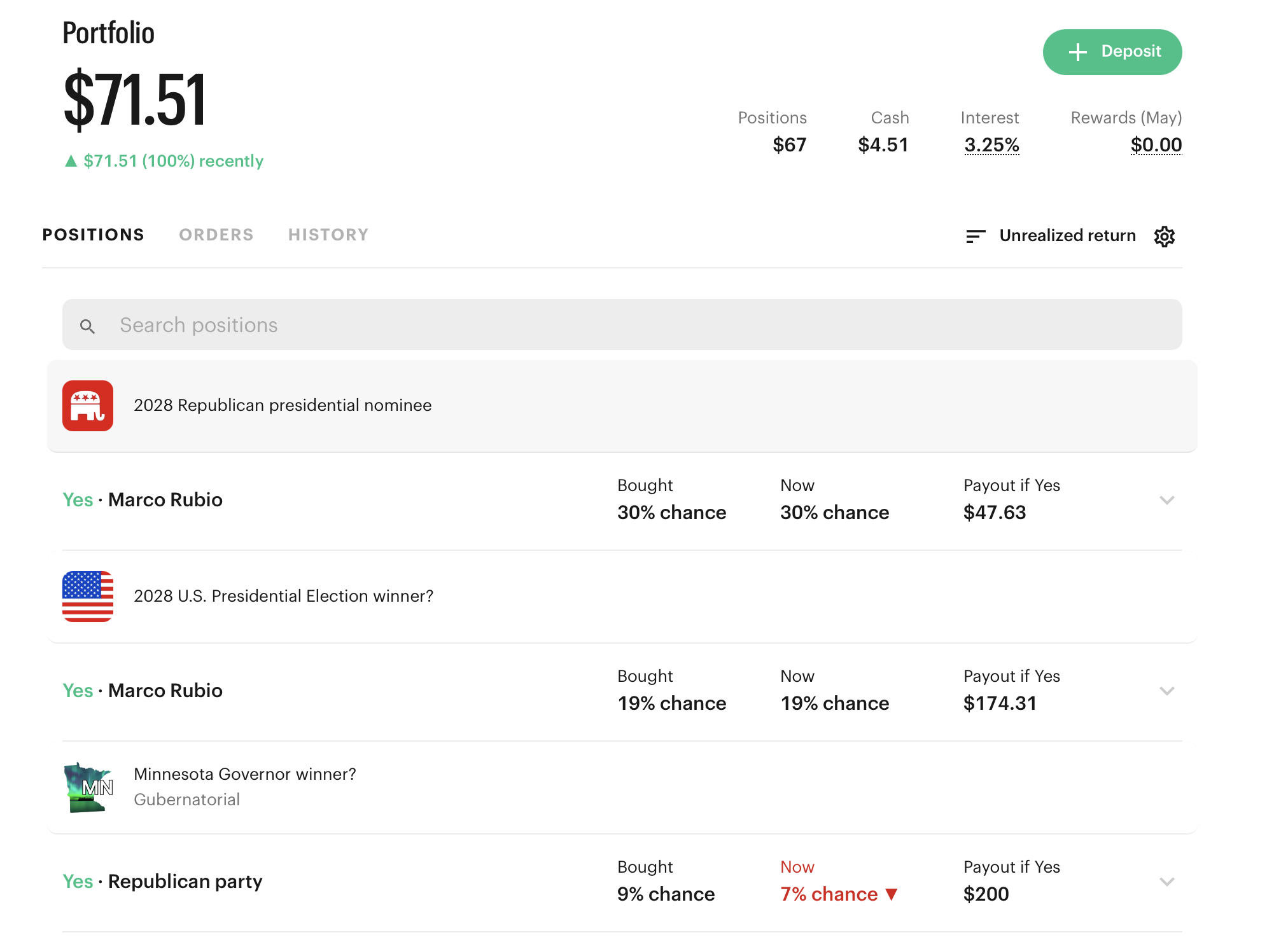
My first three small positions: Rubio for the 2028 Republican nomination, Rubio for president, and a Republican governor in Minnesota.
Hypothesis 1: Rubio 2028 as post-Trump normalization without repudiation
My first bet is that Marco Rubio will become the Republican nominee for president in 2028.
I bought the position at a 30 percent chance, and when I took the screenshot, the market still had it at 30 percent. So on the $15 I put on this bet, the payout if yes would be $47.63.
The current public narrative often favors JD Vance as the natural successor to Trump. Rubio himself has repeatedly signaled loyalty to that world. But when I think about actual electability, I wonder whether the party might eventually want something slightly different: continuity without full repetition.
My hypothesis is that Trump and Vance may absorb much of the conflict, backlash, and exhaustion associated with the current Republican era. By the time the next open Republican contest arrives, the party may want continuity without the full emotional cost of Trumpism. Rubio could offer exactly that: a continuation of the Trump coalition without making voters feel as if they are watching the same drama again.
He is close enough to the current Republican coalition not to look like a repudiation. But he is also polished enough, experienced enough, and institutionally familiar enough to feel like a breath of fresh air to voters who want the substance of the current coalition with less drama, and perhaps more compassion, clarity, and eloquence.
In short, the bet is on Rubio as post-Trump normalization without repudiation.
Hypothesis 2: Rubio wins the presidency
My second bet is conditional on my first bet being correct: Rubio wins the presidency.
I bought this at a 19 percent chance, with $35. The payout if yes would be $174.31.
This is a riskier position because it requires two things to happen. First, Rubio must become the Republican nominee. Then he must win the general election. The market price reflects both layers of uncertainty.
But the bet follows from the first. If Rubio is the normalization candidate, he may be especially valuable in a general election. He could plausibly hold much of the Republican coalition while seeming less chaotic to swing voters. The very qualities that might make him less exciting in a primary could make him more electable in November.
I also think Democrats have not yet fully reckoned with their succession problem. Republicans, by contrast, seem to be testing different versions of continuity. That does not mean they will succeed. It does mean they may be thinking more strategically about what comes after Trump than Democrats had in 2024.
Hypothesis 3: Minnesota elects a Republican governor
My third bet is that Minnesota will elect a Republican governor.
This was the longest shot. I bought at a 9 percent chance, with $20. The payout if yes would be $200.
This is the most local of the three bets and probably the one most shaped by lived observation. My hypothesis is that Minnesota may be closer to a political turn than national observers assume.
There is visible frustration around governance, affordability, public services, public safety, and institutional trust. None of that guarantees a Republican victory. Minnesota has been difficult terrain for Republicans statewide. A Republican win remains unlikely. But at a sufficiently low price, unlikely is not the same thing as overpriced.
That distinction matters. Prediction markets discipline political talk because they force us to separate preference, plausibility, probability, and price.
Predicting the future of prediction markets
Prediction markets are still strange enough to feel marginal, but they may not stay that way. By some measures, activity has grown rapidly: one industry analysis estimated that monthly transaction volume across prediction markets rose from about $1.2 billion in early 2025 to more than $20 billion in January 2026.
As prediction markets gain momentum, they become a force of their own. They do not merely reflect how people estimate probabilities. They shape attention and narratives, perhaps even behavior.
That makes them politically vulnerable.
Minnesota is already moving in that direction. Lawmakers recently passed a bill that would ban prediction markets such as Kalshi and Polymarket in the state. If signed into law, the ban is expected to face legal challenges, partly because these platforms operate in a contested space between federal commodities regulation and state gambling law.
My first three bets are small. We will know in a couple of years whether I was right or wrong.
For now, I am going to sit back and watch.
Disclosure: I placed small personal prediction-market positions on Marco Rubio becoming the Republican nominee, Marco Rubio winning the presidency, and a Republican winning the Minnesota governorship. This essay is not investment advice. It is a reflection on my first experience using prediction markets as a political economist.