Martha Stewart and What Makes for a Self-Defined Life
I have been trying to understand why Martha Stewart’s story has always had such a pull on me.
Having recently watched Netflix’s documentary Martha, I think what draws me in is the way her life represents a form of freedom so few women in history ever had: the freedom to build a self-defined life.
Martha Stewart, as she appears in the documentary, is impressive: a model and stockbroker turned resourceful entrepreneur, publisher, television personality, brand builder, and tastemaker. She is also imperfect, sometimes difficult, sometimes hard on others, and clearly human. She makes mistakes and has to endure consequences. It is likely the mistakes, the failures, and the refusal to be defined by them that make Martha Stewart feel relatable and authentic. She lives by her own taste and ambition, reaping the benefits and suffering the consequences.
As I watched, I kept thinking about how much of Martha Stewart’s success came from qualities that women have always had: taste, discipline, resourcefulness, attention, endurance, the ability to make order out of what is available. Those qualities remind me of my grandmothers. Stewart was born in the United States in 1941. My two grandmothers were born in rural Poland in 1929 and 1931, into peasant families. They were only about a decade older than Martha Stewart, and still little girls when World War II began. Yet they came of age in a radically different world.
The economic distance is hard to overstate. In 1941, the year Stewart was born, U.S. GDP per capita was about $13,553. Poland would not reach that level until 2003. America’s 1940s peak was even higher, about $16,999 in 1944. Poland did not exceed that level until 2007.
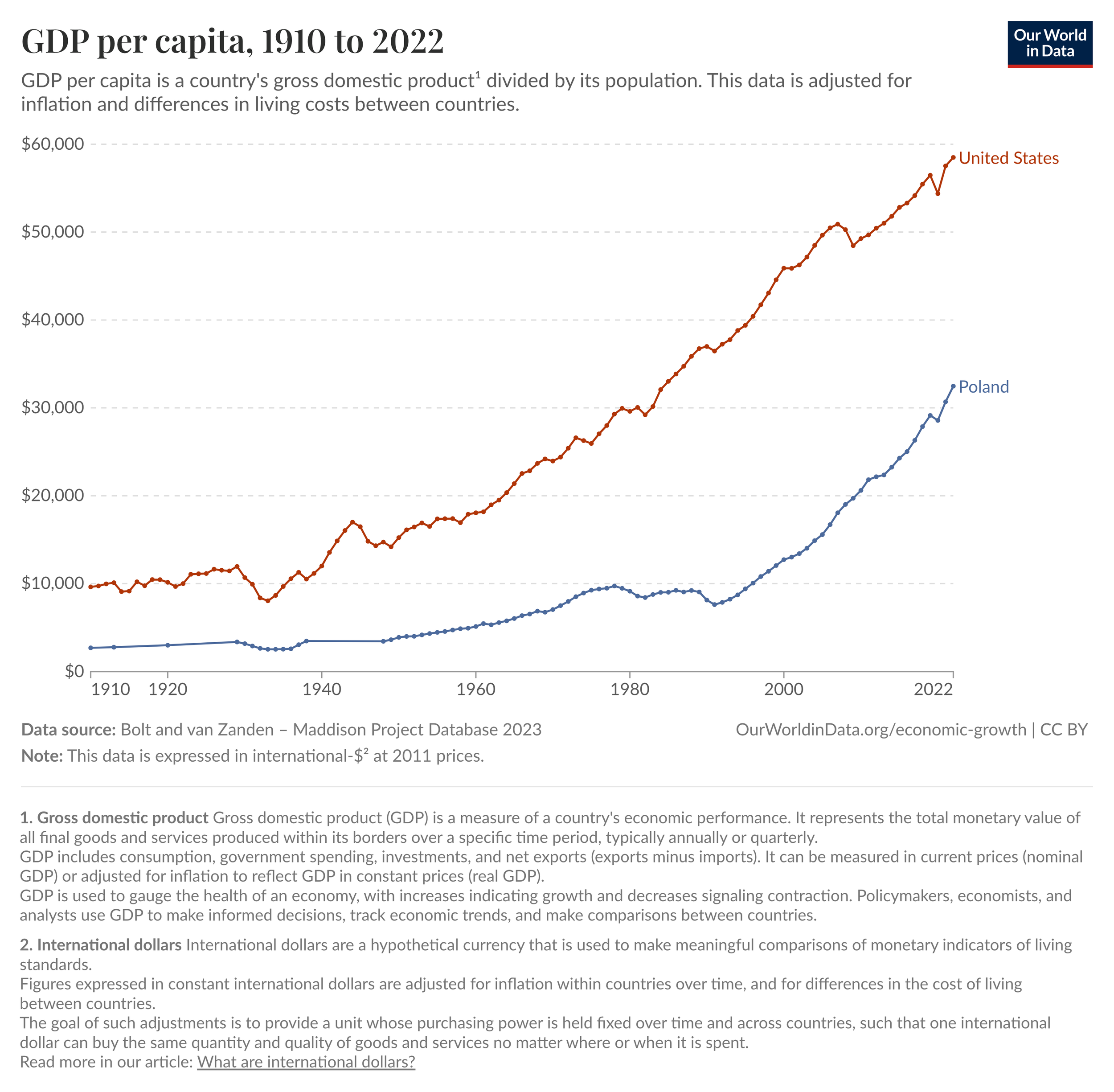
Two different worlds. GDP per capita in the United States and Poland, 1910–2022. Data adjusted for inflation and differences in living costs. Source: Maddison Project Database 2023 via Our World in Data. Poland did not reach the level of U.S. GDP per capita from the year Martha Stewart was born, 1941, until 2003. It did not exceed America’s 1940s peak until 2007.
The chart does not explain everything, but it helps show the scale of the difference. Stewart’s life unfolded in a society where she could commercialize her talents and skills. My grandmothers were no less resourceful than Martha, but their energies were spent on survival.
That is the contrast that stays with me. My grandmothers knew how to grow, harvest, and preserve food; how to organize and repair; how to stretch what was available; and how to anticipate the needs of others. They knew how to make life work under scarcity. Those same kinds of skills became, in Martha Stewart’s world, the foundation of commercial success, especially in hospitality, homemaking, publishing, and lifestyle branding.
What makes Stewart’s story so different is the unusual world in which she grew up: one in which a woman could take knowledge long dismissed as “women’s work” and turn it into wealth.
Martha Stewart, my grandmothers, and so many other women had ambition, talent, resourcefulness, and discipline. What Martha also had was a world in which a woman could define herself by building an enterprise and creating market value. Martha Stewart was not born into a perfect world; she faced her share of struggles. But it was a world in which, with a lot of hard work, some talent, and some luck, one could build a beautiful life.
That is what strikes me as so uniquely American.
Talent is everywhere. Ambition is everywhere. Women’s intelligence and creativity have always existed and contributed to society. What is rare are environments that recognize and reward that contribution.
This year, on the Fourth of July, that is what I want to celebrate: the institutional conditions that prioritize freedom and the pursuit of happiness, for all.
The documentary is worth watching even apart from this historical reading. It is a story of human agency, heartbreak, and ambiguity. One question I was left asking: after serving her sentence, had Stewart repaid her debt to society? And is there more to Martha Stewart’s version of the story? Was she, as she seems to argue, unfairly punished because of the publicity generated in the process?